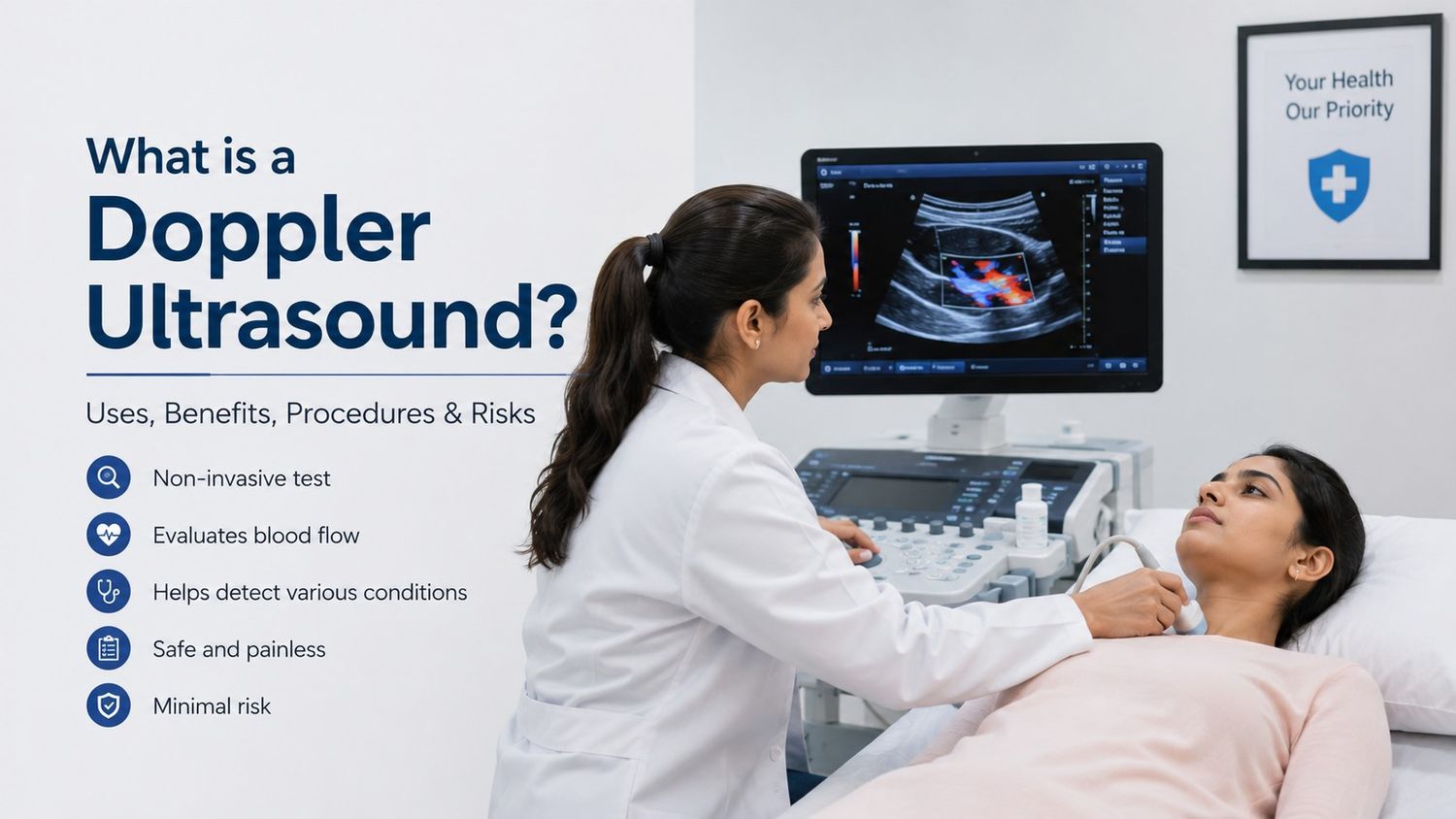
A non-invasive diagnostic imaging test that uses high-frequency sound waves to evaluate blood flow through the body's blood vessels is known as Doppler Ultrasound. The Doppler ultrasound measures the movement of the blood within arteries and veins unlike the standard ultrasound which creates the images of the tissues and the organs. This helps doctors identify abnormalities in blood circulation and diagnose various vascular and cardiovascular conditions. The Doppler ultrasound is used widely because it is the painless, safe, radiation free and highly effective technique which helps in accessing the blood flow in different parts of the body. It is widely used in the diagnosis conditions related to pregnancy, heart issues and blood vessels.
Types of Doppler ultrasounds
The different types of Doppler ultrasounds include:
- Colour Doppler: The direction of the blood flow is detected by the changes in the sound waves into different colours as shown by the computer.
- Spectral Doppler: Graphical representation of blood flow over time.
- Duplex ultrasound: The width of the blood vessels can be checked using this type of the ultrasound and it combines the traditional ultrasound pictures with Doppler ultrasound and it also helps to show the blockages.
- Power Doppler: This test is used to show even very slow blood flow and is used to shows the presence of blood flow whereas the direction of the blood flow is not shown by this type of the ultrasound and is widely used to study blood flow inside organs.
- Transcranial Doppler ultrasound: This type of the Doppler ultrasound is used to detect strokes or subarachnoid haemorrhages and determines the blood flow in your brain.
Procedure of the Doppler Ultrasound
- Doppler ultrasound uses the Doppler effect where the pitch is changes by the sound waves when they are send into your body.
- As and when the sound waves bounce off from the body’s moving cells in the blood vessels it goes back to the probe to be detected.
- In turn the auditory and visual representations of the blood flow is determined by the information through the Doppler effect.
- The direction of blood flow and how fast the blood is moving is also determined by the ultrasound.
This information provides information about:
- How fast or slow blood is moving and the actual condition of your blood circulation.
- Obstructions in the blood flow.
- Blood going in the wrong direction or pooling in a blood vessel.
Why Doppler Ultrasound is used?
- No needles or surgical procedures are involved and thus it is the non-invasive technique.
- For all the age groups this process is safe and completely painless.
- It provides detailed insights into vascular health.
- The results are very quick and the entire process is very cost effective.
- Early detection of the diseases is important and it provides the real time images of the body parts under examination.
Common Uses of Doppler Ultrasound
Doppler ultrasound is used in a variety of medical conditions and it has following common uses:
- Blood Clots detection.
- Narrowed arteries and blocked diagnosis can be determined easily.
- Evaluating Varicose Veins.
- Heart conditions can be monitored.
- Pregnancy and its changes can be monitored.
- Organ blood supply can be examined.
- Assessing Peripheral Artery Disease (PAD)
- Detecting Aneurysms
Benefits of Doppler Ultrasound
Following are the benefits of the ultrasound:
- The precise and clear images are obtained in this process.
- Cleanliness and patient safety is considered as the priority.
- Transparent and competitive rates for the ultrasound.
- The detailed explanations are provided during the results analysis.
What are the risks of a Doppler ultrasound?
A Doppler ultrasound is a non-invasive, low-risk test. It does not require injectable contrast dyes like an angiogram or use radiation like X-rays or CT scans. Ultrasounds are not harmful or painful. They are safe enough for providers to use on someone who is pregnant.
Conclusion
Doppler ultrasound is a versatile and essential tool in modern diagnostics. The applications of the ultrasound are vast and impactful and the technique is painless and safe and it helps the doctors to diagnose your blood vessel health and know about any cardiovascular diseases. While it has some limitations, its numerous benefits make it one of the most commonly used imaging tests in modern healthcare. Doppler ultrasound plays an important role in improving patient care and treatment outcomes by enabling the early detection and accurate diagnosis.