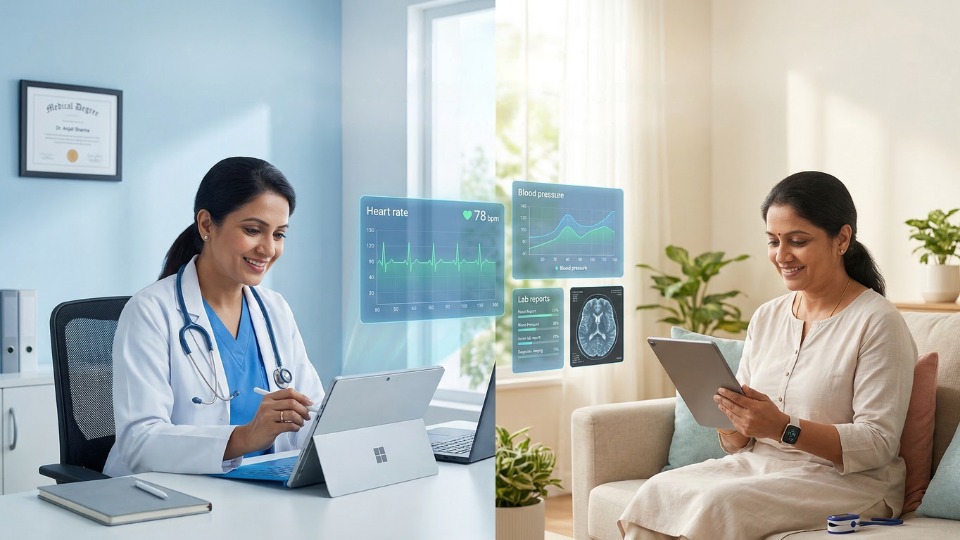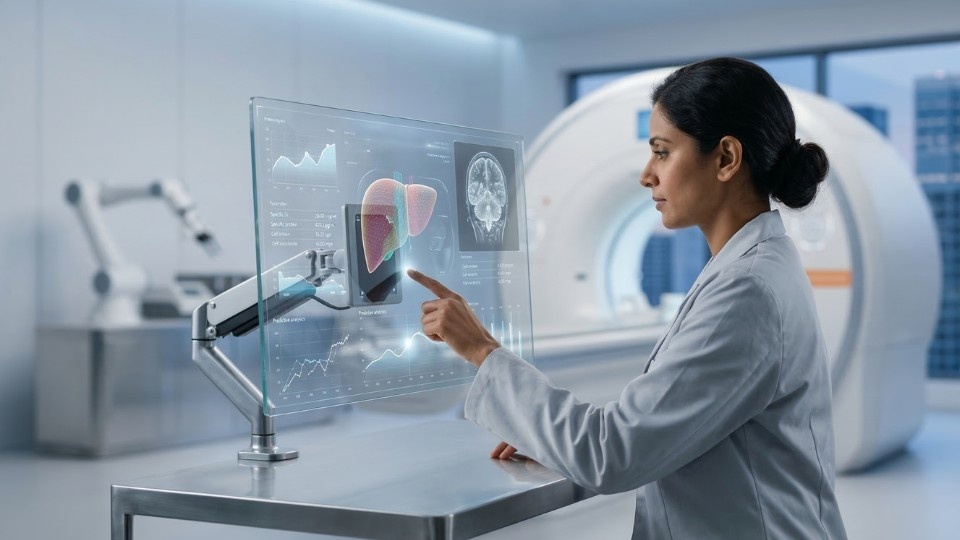
The development in the field of Artificial Intelligence (AI) and Machine learning have revolutionised the diverse possibilities in the field of healthcare. The various aspects of medical practice, from early detection of the diseases to the accurate diagnosis and the planning of the treatment all has been made easy with the evolution of these two domains. The comprehensive and detailed visual information about the human body is provided by the medical imaging techniques such as Computed Tomography (CT), Magnetic Resonance Imaging (MRI), and Positron Emission Tomography (PET), vast amount of the data is generated by these techniques that require efficient analysis and interpretation, which is very well aided by the AI.
As we know, CT (Computed tomography) is a medical imaging technique that uses X-rays and computer technology to create detailed cross-sectional images of the body. It helps doctors examine bones, organs, and blood vessels and detect conditions such as fractures, tumours, internal bleeding, or infections. An MRI scan is a medical imaging technique that uses strong magnetic fields and radio waves to produce detailed images of the body’s internal structures. It is especially useful for examining soft tissues such as the brain, spinal cord, muscles, ligaments, and internal organs. Both techniques are widely used, and in case of emergencies, CT scan is often chosen because of its speed and for the detailed evaluation of the soft tissue injuries, MRI scan is usually used. The interpretation of the results of these techniques is made easy by the use of Artificial Intelligence and Machine learning tools.
More accurate diagnosis and treatment regimen is made easy by the specific genetic variants and molecular markers which help to identify the tumours. AI-powered liquid biopsy methods advance non-invasive cancer screening by detecting circulating tumour DNA and other blood-based biomarkers. Biomarkers are the indicators of the normal biological processes, pathogenic processes to therapeutic interventions; these are used to interpret the biological tests results, these markers ranges from basic screening panels to advanced specialty tests. Thus the real time monitoring of the disease and treatment response is enabled by the use of AI. The increase in the accuracy, speed and detection of the disease has increase because of the advancement in Artificial inelegancy (AI) and Machine Learning (ML). These two approaches are widely used in the cancer diagnosis process, ranging from imaging analysis to genetic profiling.
Across the entire healthcare spectrum, Artificial intelligence (AI) is rapidly emerging as a transformative force, which offers the opportunities to enhance clinical efficiency redefine medical practices and improve the outcomes for the patient. Within the pathology, dermatology, radiology these have been successfully applied in image analysis and helps to achieve the diagnostic at a speed that is very accurate and more than in the normal diagnostic practices. Precision therapies, reduce medical errors, and enhance subject enrolment in clinical trials suggest that AI has the potential to optimise the care trajectory for chronic disease patients.
Artificial Intelligence (AI) and machine learning algorithms are the computational powers which are required for interpreting the complex biological datasets. Correlations within genomic, proteomic, and metabolomic data and the intricate patterns can be identified by these technologies and these are imperceptible to human analysis. To forecast disease risk with increasing accuracy, predictive profiles can be built by the AI models from the historical data. More personalized and pre-emptive healthcare strategies are enabled by the predictive diagnostics across various medical fields around the world.
AI Clinical Support is so important due to following reasons:
- Scalable monitoring
- Data-driven decision frameworks
- Patient’s trust increases
- Diagnostic errors are reduced
- Operational costs reduces
- Readmission rates are lowered
- Clinician efficiency is increased
Ai systems can analyse medical images with precision, accuracy and speed, they make it effective by the machine learning algorithms. The early detection is very crucial in the healthcare domain because it paved the way for improving treatment outcomes and save the lives. The development of the personalized medicine has been due to the integration of the AI and machine learning in the field of Medical science. Through the analysis of medical images and patient data, AI algorithms can generate patient-specific insights, enabling tailored treatment plans which in turn minimizes the risk of adverse effects, and improves the quality of life. Also AI has opened the door for new possibilities in image segmentation and quantification.
Heath screening is becoming time efficient and budget friendly because of the integration of the AI The routine set of tests and checks is known as health screening. These tests and scans include simple tests such as blood pressure, sugar test and in general does not necessary account for the diagnostic tools, these scans help to determine or detect the serious problems in our body before the problem gets more difficult to handle. With the advancement in the domain of the Machine learning and artificial intelligence the interpretation of the screening tests reports, whether results are within normal limits or require follow-up, has become very easy. Assessing overall wellness is essential for the regular monitoring and understanding the health status of an individual which in turn will help to determine the best treatment and medication methods before starting the exact treatment process.
AI’s application of natural language processing (NLP) to scientific literature and electronic medical records has significantly impacted the medical practices. Clinical errors caused by human cognitive biases can be mitigated through machine learning thereby enhancing the care of the patient. The shift of the traditional methods to AI integrated methods has the potential to address enduring challenges in medical imaging. The demand for the modern healthcare systems and diagnostic complexities has increased due to the convergence of the AI and medical imaging techniques.
A subset of AI that uses data as an input resource is known as Machine Learning (ML). It has enabled early and accurate disease detection in the field of medical diagnostic and it uses the algorithms to analyse complex medical data, identify patterns, and make predictions better than the traditional methods in terms of the precision and efficiency of the results. A wide range of the diseases has been diagnosed using the technique of the Machine Learning such as heart diseases, kidney diseases, and Covid-19. Also the ML models like Convolutional Neural Networks (CNNs) helps to analyse the data obtained through medical imaging such as MRIs and CT scans in order to determine the tumours with the high accuracy. ML models process electrocardiogram (ECG) signals to detect abnormalities in the heart and diagnose the inaccuracies in the working of the heart. Learning models helps to classify chest X-ray and CT images in order to identify infections. Machine Learning based disease diagnosis (MLBDD), is inexpensive and time-efficient whereas the traditional processes of the diagnosis are time consuming and costly and often require human intervention. Since the usual traditional diagnostic methods are hampered by the human intervention while there is no such limitations, in the Machine Learning based disease diagnosis (MLBDD) technique. MLBDD yields a result which is difficult for the humans to accomplish. The technology’s utility in medical fields is illustrated by the emergence of machine learning (ML) algorithms in disease diagnosis.
Challenges of the Machine Learning based disease diagnosis (MLBDD):
· Data scarcity
· Noisy datasets
· Interpretability issues
· Data limit models
· Ongoing advancements in algorithms
· Ethics in medical domains
All these major challenges can be overcome by developing explainable AI models, enhancing data collection methods, and employing ensemble learning techniques to improve robustness. Also the data limitations are overcome by using the Transfer learning.